
Supervising Doctoral Students Today
Navigating Complexity in Shifting Terrain
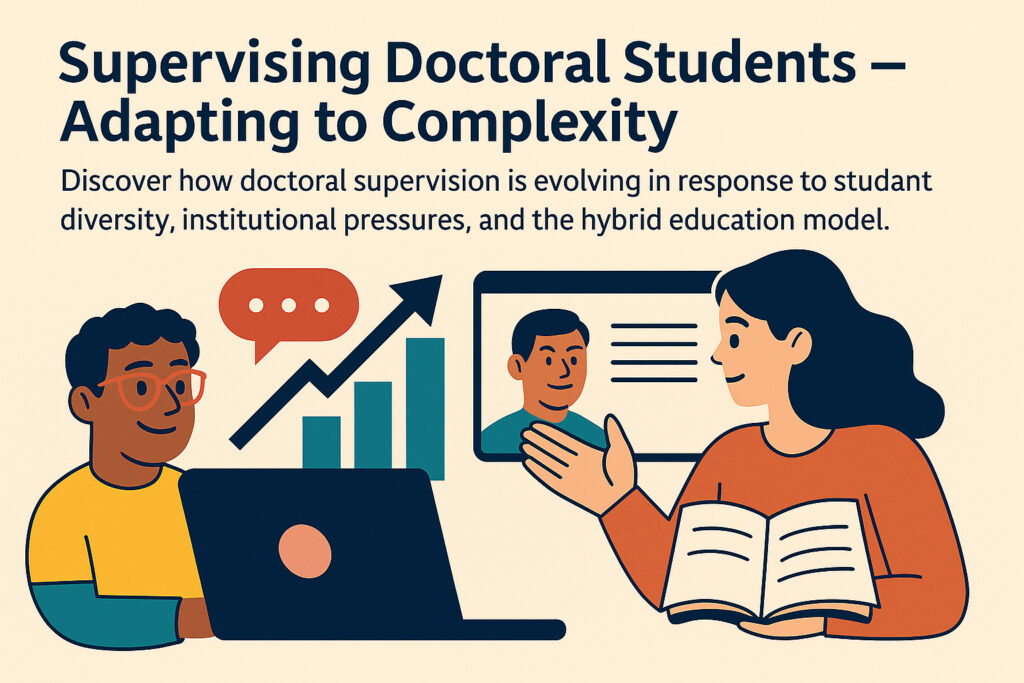
Doctoral supervision has always required judgement, care, and a finely tuned balance between support and autonomy. But in recent years, the role of the supervisor has become significantly more complex — shaped by institutional pressures, policy shifts, and the changing nature of doctoral education itself.
Many of us now supervise students whose pathways into doctoral study differ markedly from traditional models. Some candidates come with substantial professional experience and return to academia after long gaps; others are entering directly from master’s programmes but with varying degrees of research readiness. This diversity brings enormous intellectual value, but it also requires a more flexible and individualised supervisory approach — one that is sensitive to prior knowledge, working patterns, and differing expectations of academic culture.
Supervision is also no longer confined to academic guidance alone. Increasingly, we find ourselves providing support that touches on wellbeing, career development, and sometimes even personal resilience. While universities have taken steps to bolster pastoral services, it remains the case that supervisors are often the first to notice when a student is struggling — whether academically, emotionally, or financially. Knowing when to step in, how to offer support, and when to refer to others is part of the craft, but one that receives surprisingly little formal attention.
There are also structural challenges. The intensification of academic workloads — including research metrics, administrative responsibilities, and expanding teaching portfolios — means that time for supervision can become squeezed. In some institutions, doctoral supervision remains undervalued in workload models or promotion criteria, which sends a confusing message about its importance in academic life. This tension between institutional expectations and professional commitment is something many of us navigate quietly, but it has real implications for the quality and consistency of supervision we are able to provide.
Moreover, the rise of online and hybrid doctoral programmes, international collaborations, and inter-disciplinary projects requires us to work across different institutional cultures, time zones, and sometimes even regulatory systems. While these arrangements create new opportunities for research and exchange, they also complicate the supervisory relationship. Questions around intellectual ownership, feedback cycles, and progression monitoring take on new dimensions in virtual or distributed supervisory teams.
What becomes clear in all this is that supervision is no longer a static or narrowly defined role.
What becomes clear in all this is that supervision is no longer a static or narrowly defined role. It is relational, evolving, and shaped by the contexts in which we work. As supervisors, we benefit from reflective spaces to share experiences, exchange strategies, and challenge assumptions. Without this, there is a risk that we carry the increasing complexity of the role in isolation.
Acknowledging the changing nature of supervision is not an admission of inadequacy — quite the opposite. It allows us to be more intentional, better equipped, and more ethically engaged in our work. At a time when doctoral education is under growing scrutiny, the value of thoughtful, well-supported supervision has never been clearer.