
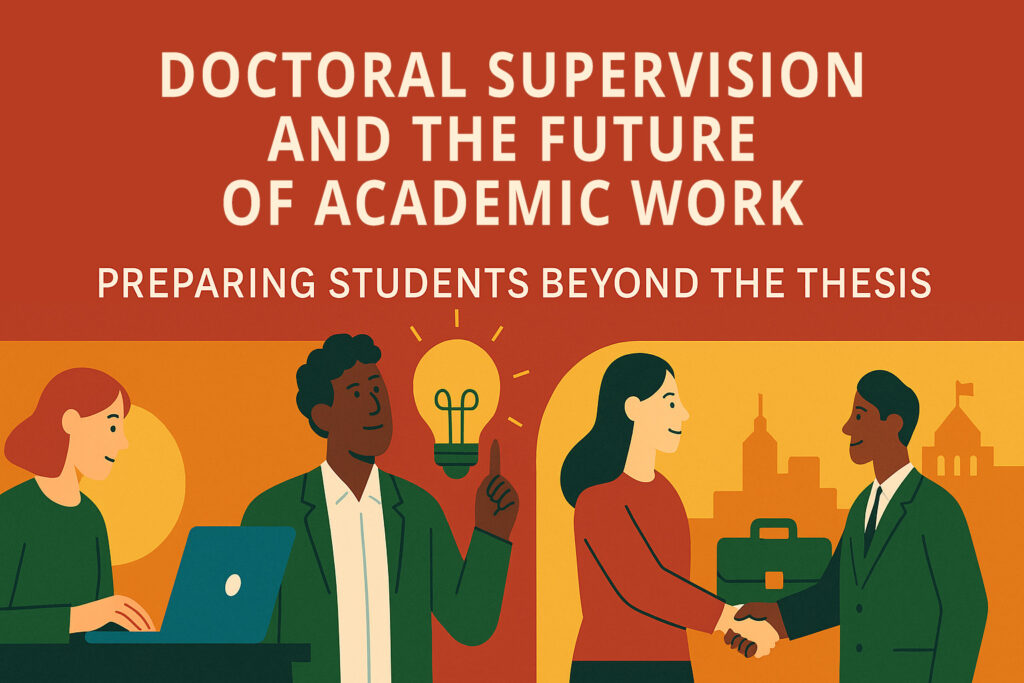
For decades, doctoral study has been understood — implicitly or explicitly — as preparation for an academic career. The structure of the PhD, the emphasis on independent research, the apprenticeship model of supervision: all have been built around the assumption that students will become academics. But the academic landscape is shifting. Permanent academic roles are increasingly scarce, competition is high, and many doctoral graduates are pursuing fulfilling and impactful careers outside the university.
This evolving reality raises important questions for supervisors. What is our role in preparing students not only for thesis submission, but for life beyond it? How can we equip them with the knowledge, confidence, and flexibility to pursue diverse futures, whether within or beyond the academy?
Supervisors do not need to become careers advisers. But we do hold significant influence over how students perceive their options and how they position themselves professionally. The language we use, the networks we share, the opportunities we highlight — all of these shape a student’s sense of what is possible.
Too often, the conversation about “alternative” careers happens too late — framed as a fallback rather than as a legitimate and valuable pathway. But many students, including those with interdisciplinary projects, applied research interests, or prior professional experience, are already considering a range of futures. Bringing those conversations into supervision early and without judgment is one way to show that all outcomes are valid, and that research skills are transferable across sectors.
Practical steps can help. Encouraging students to present to different audiences, to publish in formats beyond journals, to engage with external stakeholders — these experiences broaden a student’s perspective and increase their visibility. Supporting them to attend workshops on public engagement, policy writing, or entrepreneurship can also help build a portfolio of skills that go far beyond disciplinary expertise.
“In truth, doctoral education is not — and never has been — a pipeline. It is a journey of intellectual growth and professional development that can lead in many directions.”
It’s also important to model openness in our own academic identities. When we talk honestly about our own careers — including non-linear paths, rejections, or shifts in focus — we help dismantle the myth that there is only one route to success. Supervisors who show curiosity and humility about the future of academic work invite students to do the same.
In truth, doctoral education is not — and never has been — a pipeline. It is a journey of intellectual growth and professional development that can lead in many directions. The best supervision recognises this diversity, affirms it, and helps students build futures that are grounded not only in knowledge, but in confidence, adaptability, and a sense of purpose.
Join a Peer Mentoring Session