
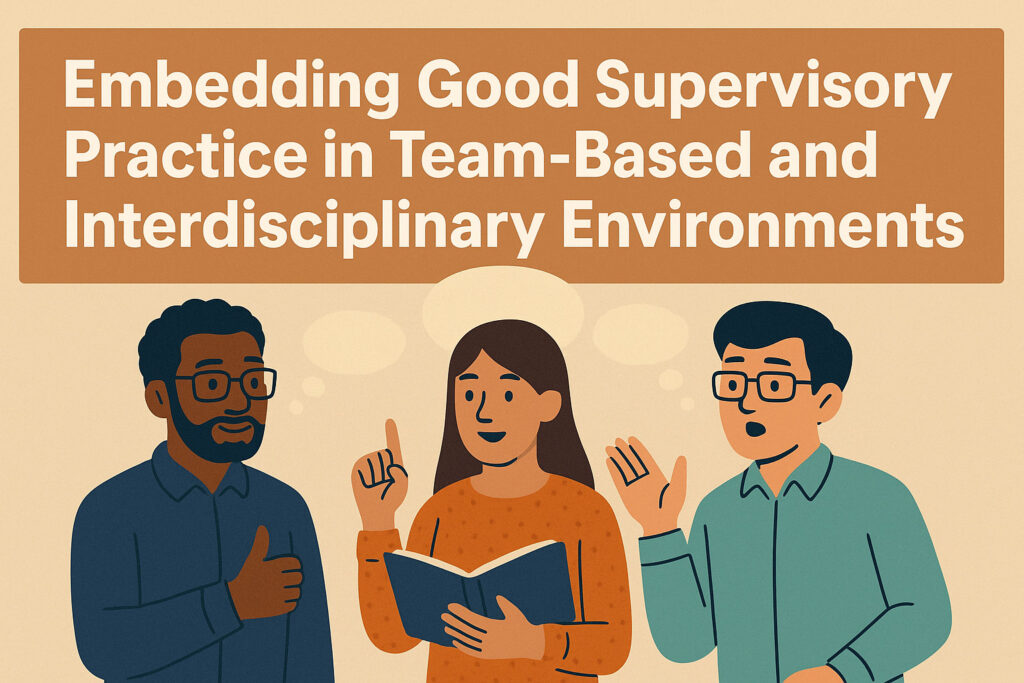
As doctoral projects become increasingly collaborative, interdisciplinary, and embedded in broader institutional or industry partnerships, the nature of supervision is evolving. It is no longer unusual for a candidate to have two or even three supervisors from different disciplines or institutions — each bringing different priorities, perspectives, and expectations. These arrangements create exciting opportunities for research, but they also introduce complexities that require careful navigation.
Good supervision in these environments begins with clarity. When students receive mixed messages, or experience tension between supervisors, it can lead to confusion, anxiety, and delay. That is why team-based supervision requires early and explicit conversations about roles, responsibilities, and communication styles. Who leads the supervisory process? How will feedback be coordinated? What happens if advice conflicts?
These questions cannot be answered once and for all. They must be revisited as the project develops and as relationships evolve. Effective teams make time for this kind of alignment, recognising that good supervision depends not only on individual expertise, but on collective coherence.
Interdisciplinary supervision brings particular challenges. Supervisors may come from different methodological traditions, hold different expectations of what constitutes a strong thesis, or use unfamiliar terminology. In such cases, it helps to remember that the student is often the one trying to integrate these different influences. It is our role to ensure that the diversity of input is enriching, not overwhelming.
“Good supervision depends not only on individual expertise, but on collective coherence.”
This kind of work benefits from training and institutional support. Supervisors need spaces to reflect on their practice, especially when co-supervising across disciplines or organisations. Institutions, in turn, should offer guidance on how to structure team supervision effectively, how to resolve conflicts constructively, and how to ensure that the student remains at the centre of the process.
Done well, team-based supervision can model collaboration at its best. It teaches students how to navigate complexity, how to synthesise diverse perspectives, and how to hold multiple identities as researchers. But it requires attention, communication, and care — the very qualities that define good supervision more broadly.
Join a Peer Mentoring Session